Normanville HAB Monitoring Group Report: 11 February 2026
Establishment of the HAB Laboratory

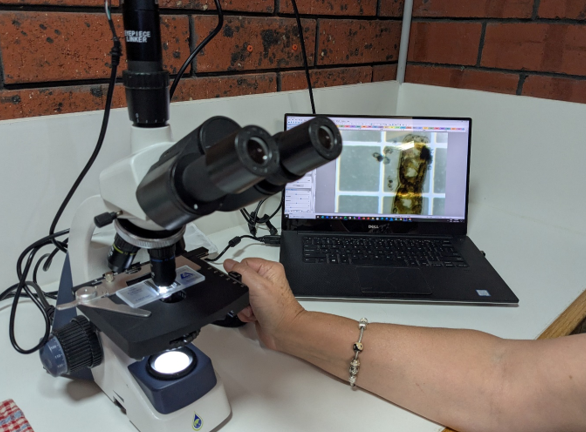
The Harmful Algal Bloom (HAB) Laboratory is now fully operational at the Fleurieu Environment Centre (FLEC). We are sincerely grateful to the FLEC team for their support in preparing and setting up the laboratory space.
The laboratory is equipped with a microscope purchased through a grant from the Community Op Shop. We have also received generous donations of additional equipment from the Phytoplankton SA Group and Professor Karin Hatch, significantly strengthening our monitoring capacity.
- Grant Applications
We have submitted a funding application to the Algal Bloom Coordination Unit under the Coastal Infrastructure Grants program. We understand that this application is still under assessment.
If successful, the funding will enable us to:
• Purchase an additional microscope
• Acquire further sampling equipment
• Undertake advanced team training with phytoplankton scientists
This support would substantially enhance both our technical capacity and the resilience of our volunteer monitoring team.
- Training and Capacity Building
We extend our sincere thanks to the Phytoplankton SA Group for their ongoing support, advice and training.
As our volunteer base grows, we are seeking additional funding to deliver dedicated workshops in phytoplankton identification and sampling methodology to ensure consistency, accuracy and scientific rigour across the team.
- Monitoring and Sampling Program
Since mid-December 2025, the group has been conducting regular monitoring across the Western Southern Fleurieu Peninsula, including:
• Morgan’s Beach
• Rapid Bay (Jetty and Beach)
• Second Valley (Jetty and Beach)
• Wirrina Cove
• Normanville (Jetty and Beach)
• Carrickalinga
We are currently collecting between three and five samples per week. We are also collaborating with local dive groups to obtain deeper-water samples, strengthening the quality and representativeness of our data.
Each sample requires a minimum of two hours to:
• Collect in the field
• Analyse live under the microscope
• Prepare and stain for counting
• Conduct cell identification and counting
This represents a significant and ongoing volunteer commitment.
- Data Validation and Scientific Integrity
Throughout our training and monitoring activities, all data has been shared with experts from the Phytoplankton SA Group for validation.
We also utilise multiple reference sources to ensure accurate identification, including:
• iNaturalist
• Scientific literature and identification guides
• Peer-reviewed papers
• Specialist microalgae networks and forums
Maintaining scientific credibility and accuracy remains a core priority for the group.
- Reporting and Current Conditions
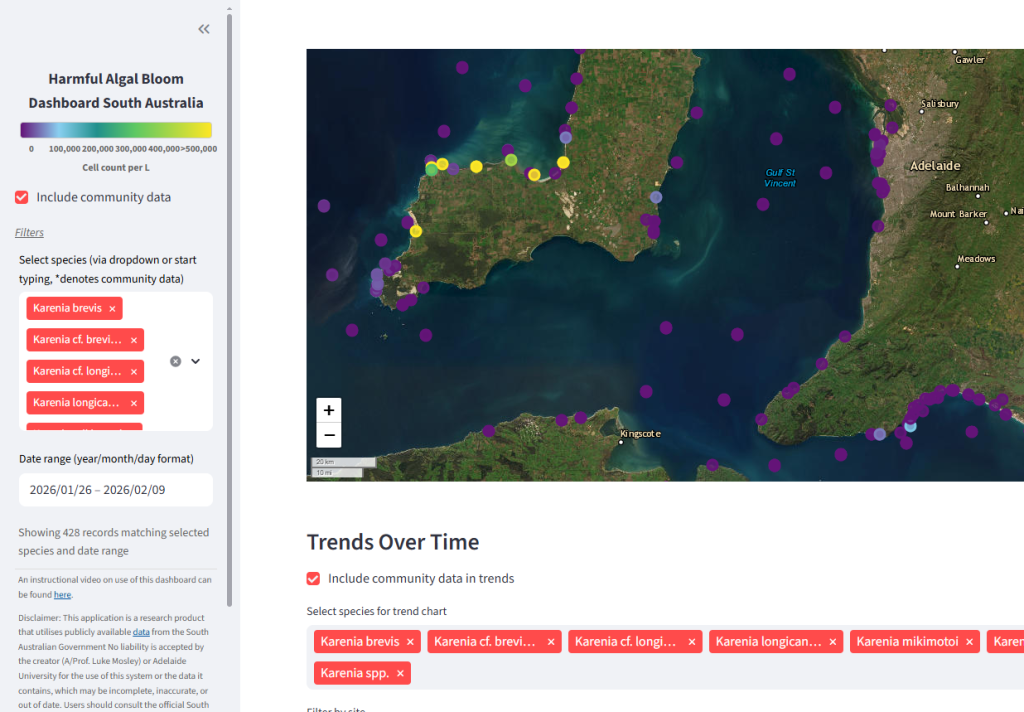
Each week, we complete a standardised data spreadsheet and submit it to the Algal Bloom Dashboard team. Following verification, the data is uploaded to the South Australian Harmful Algal Bloom Dashboard:
https://sa-algal-bloom.streamlit.app/
Recent dashboard data shows:
• A renewed flare-up of Karenia species at the tip of the Yorke Peninsula
• Yellow indicators representing high concentrations
• Purple indicators representing low to negligible concentrations
Encouragingly, the Western Southern Fleurieu Peninsula continues to record low to zero levels, with all recent samples testing clean. However, significant flare-ups have been recorded on Kangaroo Island and in Encounter Bay.
- Ongoing Commitment
This is a long-term citizen science project. The Normanville HAB Monitoring Group will continue regular testing to:
• Build baseline ecological data
• Track seasonal and spatial trends
• Support early detection of blooms
• Contribute to statewide monitoring efforts
Our work strengthens regional response capacity and provides valuable local data that can inform future environmental management and public health decisions.